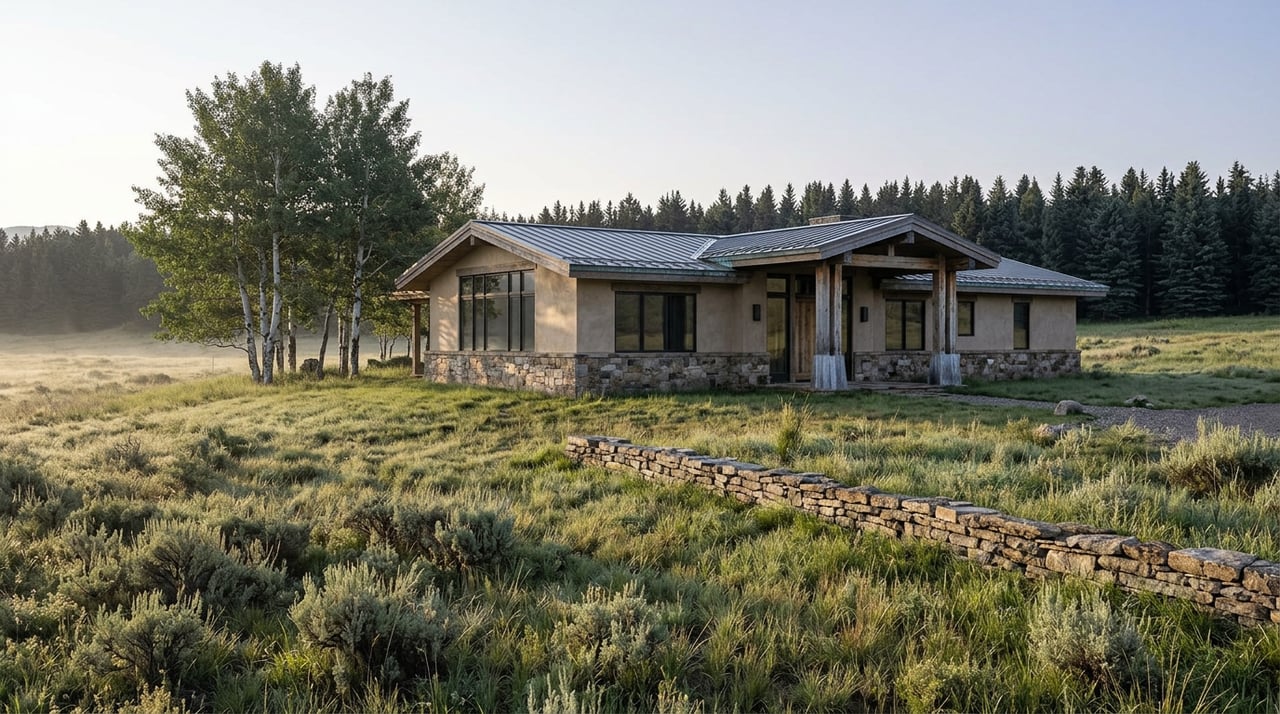
Walk the loop trail from the Willow Creek Park dog pond north toward the big tree along the fence line, and you land at the entrance to the Green Heart of the Basin, a free five-kilometer Nordic ski track laid out on 158 acres that will never be built on. KPCW reported that the farm behind it, still worked by the Osguthorpe family, is protected forever under a conservation agreement finalized in 2019.
A short drive away on the same road sits another 158-acre field. Same zoning designation. Same rural feel from the road. Different ending, still being written.
That second parcel is the subject of an active subdivision application before the Snyderville Basin Planning Commission, and the way it plays out says more about what "open space" protection actually guarantees on Old Ranch Road than any listing description will tell you.
Same Road, Same Acreage, Two Different Bets
KPCW reported that Summit County Community Development Director Peter Barnes described the central Snyderville Basin as having two large undeveloped squares left, aside from the Swaner Preserve: the Osguthorpe Farm, groomed for Nordic skiing most winters, and a second parcel with an active subdivision application that may move forward this year. Both tracts run close to 158 acres. Both sit under the same "rural residential" zoning, which normally allows one home per 20 acres. From there, the paths split.
| Osguthorpe Farm | The 2H2O Parcel | |
|---|---|---|
| Size | 158 acres | 158 acres |
| Current status | Conservation agreement finalized in 2019 | Active 14-lot subdivision application |
| How it got there | Conservation easement purchase | Open-space density incentive |
| What locals can do there | Free public Nordic skiing, ski-only | Not yet public, currently a working parcel |
| Owner | Osguthorpe family, ranching since the 1940s | LLC "2H2O," registered to Chad Horne |
| Long-term outcome | Protected under the conservation agreement | Up to 14 residential lots, pending approval |
The Osguthorpe Farm got there through an outright purchase of development rights. The nonprofit Summit Land Conservancy raised close to $18 million to make it happen, anchored by an $8.8 million federal matching grant, a $3.9 million gift from the Osguthorpe family itself, and roughly $4.5 million from more than 1,200 individual donors, with Summit County adding $500,000. The farm is now formally recognized as a Heritage Amenity in the Snyderville Basin General Plan, and the family's sheep operation, Red Pine Livestock Company, still runs on the land the rest of the year.
The 2H2O parcel is taking a different route entirely, and it is worth understanding exactly how.
The Code That Sounds Like Conservation Is Also a Density Tool
Old Ranch Road's baseline zoning caps development at one home per 20 acres. On a 158-acre tract, that math suggests something like seven or eight homesites at most. But Summit County's development code includes an incentive: preserve 75 percent of a property permanently, and the owner can build more units per acre than the base zoning would otherwise allow.
That is exactly what the current application is testing. County records list the project as "Old Ranch Estates," a 14-lot preliminary subdivision plat spanning three parcels, filed under project number 25-185. The applicant is engineer Farley Eskelson, representing property owner 2H2O, the LLC registered to Chad Horne. The county's principal planner on the file is Jennifer Strader.
Read that plainly and the number that jumps out is 14, not 7 or 8. The incentive built to protect open space is the same mechanism that clears the way for nearly double the density a straightforward zoning read would suggest, so long as most of the acreage gets locked up in a conservation agreement around the built lots.
A public hearing on the plat was scheduled for February 10, 2026, at the Sheldon Richins Building in Park City. It was cancelled. Barnes explained why on KPCW's Local News Hour on February 4: the county and the applicant are still negotiating the terms of that conservation agreement itself, and those conversations are complex enough that the hearing was pushed to a date the county has not yet set.
A Decade of Starts and One Ironic Detail
This is not a new idea that surfaced overnight. Barnes has said the plan to subdivide the 2H2O property dates back to at least 2016. At one point, the county planning department approved a subdivision at base density, without the open space incentive attached, and that version never moved forward. The current 14-lot version, built around the density bonus, is the one now working through the conservation-agreement negotiation.
One detail worth sitting with: Summit Land Conservancy's own donor records list Chad Horne as a contributor who helped preserve the Osguthorpe Farm, the very parcel now locked into permanent open space just down the road from the land his LLC is trying to subdivide. It is not a contradiction so much as a reminder that "preserving open space" and "building homes" are not opposites in Summit County's code. They are two settings on the same dial, and a single landowner can use both.
What This Means If You're Looking at a Home Near the Last Open Field
If part of Old Ranch Road's appeal for you is the unbuilt land around it, the base zoning number on a parcel is not the whole story. A "rural residential, one unit per 20 acres" designation describes a ceiling under current rules, not a promise about what gets built if an owner applies for the open space incentive instead.
Three things follow from that:
- The county's own development code can produce more density on paper than the zoning label implies, provided the applicant agrees to preserve most of the parcel elsewhere. That trade is legal, it is intentional, and it is exactly what is being negotiated on this property right now.
- These processes run long. A subdivision idea first floated around 2016 is still working through conservation-agreement details a decade later, with no hearing date currently set. If you are weighing a purchase near undeveloped land, plan for years of uncertainty rather than a quick resolution either way.
- The eventual footprint, if approved, will likely cluster homes on a smaller share of the acreage while the rest gets permanently protected. That can preserve long sightlines even with more rooftops than the base zoning suggests, but it changes where those rooftops sit relative to what you can see from your own windows today.
None of this makes Old Ranch Road a riskier bet than any other Wasatch Back neighborhood with open land nearby. It just means the open field across the fence deserves the same due diligence as the house itself.
The Part of the Neighborhood Already Settled
While the 2H2O parcel works through its process, Willow Creek Park remains the neighborhood's realized version of open space done and paid for. The park covers 17.5 acres and anchors daily life here with a dog park and pond, eight pickleball courts, two tennis courts, sand volleyball, and a playground, all maintained by Basin Recreation. The pickleball courts got a full resurfacing in the summer of 2025, and Basin Recreation rolled out a tennis court reservation system that same year after a successful pilot the year before, running one-hour blocks from May through September.
From the park, the Green Heart 5k Nordic loop on the conserved Osguthorpe land is a short walk north, ski-only in winter with no dogs, bikes, or foot traffic permitted on the track itself. It is the tangible result of what permanent conservation looks like once the paperwork is finished, sitting a few hundred yards from a parcel still negotiating what its own version of open space will mean.
Questions Worth Asking Before You Write an Offer Near Open Land
Is there a pending land use application on an adjacent or nearby parcel? Summit County's Snyderville Basin Planning Commission posts hearing notices publicly, and a call to the Community Development office will tell you whether anything is active on a specific tract.
What zoning incentive is being requested, and what does it actually unlock? A density bonus tied to open space preservation can allow more units per acre than the base zoning suggests, not fewer. Ask specifically what the base allowance is and what the requested incentive would change.
How long has the application been active, and what is the timeline for resolution? Some of these processes move in months. Others, like this one, stretch across a decade with hearings that get postponed while agreement terms get worked out. Knowing which kind of timeline you're dealing with matters for how you weigh the view today against what it might look like in five years.
FAQ
Has the Old Ranch Estates subdivision been approved? As of the most recent public update, no. The February 10, 2026 hearing was cancelled and moved to a date the county has not yet announced, while negotiations over the conservation agreement continue.
Does buying near open land guarantee it stays undeveloped? No. Zoning designations describe current allowances, not permanent guarantees.
Where can I check on pending applications near a specific property? Summit County's Community Development office and the Snyderville Basin Planning Commission's public hearing notices are the primary sources, and they cover parcel-specific filings by project number.
Land use decisions like this one shape what a home on Old Ranch Road will actually feel like to own five or ten years from now, and reading the zoning code correctly takes more than a glance at a map. If you're weighing a purchase near open land anywhere in Park City or the Wasatch Back, Cathy Schaede can walk through what's pending on a specific parcel before you write an offer. Let's Connect.
This article is general information, not legal, tax or financial advice. Consult a qualified professional about your situation.